A September morning in Poland can start with sunshine and end with cold rain just when you need to head home from work. For a cycling commuter, the rain itself is rarely the problem. More trouble is caused by a wet laptop, fogged-up glasses, late braking, splashing wheels, and clothes that become as damp from sweat as from rain after a few kilometers. The good news is simple: most of these problems can be mitigated without turning your city bike into an expedition machine.
Riding a bike in the rain requires three things: a more sensible technique, a well-thought-out luggage protection system, and a few minutes of bike maintenance upon return. Equipment helps, but it won't replace assessing the road surface or maintaining a calm pace. The best setup isn't the one with the most accessories, but the one that fits the distance, type of luggage, and where you can dry your clothes.
In this guide, we focus on realistic Polish commutes: from five kilometers in the city, through a longer suburban section, to a ride with a child. We explain how to read waterproofing ratings, where to store electronics, how to brake on wet asphalt, and what to check before your next trip. This way, rain stops being a surprise and becomes a condition for which you have a ready procedure.
Table of Contents
Before you go: change your plan, not just your clothes
Check rain intensity and time buffer
An hourly forecast is more useful than a general rain symbol for the entire day. You’ll prepare differently for a twenty-minute drizzle than for continuous rain and gusty winds. If the radar shows a short, intense cell, it’s safer to wait a dozen minutes than to start at the worst moment. For constant rain, add about a quarter to your usual travel time. This margin allows you to brake earlier, take turns more calmly, and avoid making up for delays with a risky pace.
Before leaving, ask yourself three questions: do I have a dry place to change clothes, am I carrying electronics, and does the route go through sections with poor drainage? If the answer to the last question is "yes," choose a parallel street or bike path, even if it means an extra kilometer. The depth of puddles cannot be reliably assessed while riding, and asphalt damage, a curb, or a loose manhole cover can be hidden under the water.
Sixty-second bike check
Squeeze both brake levers, rotate the wheels, and check that the tires are not visibly underinflated. Wipe dirt from the surface of the lights and reflector. Shake your bag to ensure that the fastenings have not loosened since the last ride. In the rain, a minor defect quickly becomes a problem: a weak brake extends reaction time, a loose bag can touch the wheel, and a dirty light is less visible.
- functional brakes and correct tire pressure;
- front and rear lights on in limited visibility;
- bag compartments closed and strap ends secured;
- a dry change of clothes if there's no drying room upon arrival;
- phone in an accessible place without unzipping the entire bag.
Waterproof bike bag: what really protects your luggage
The terms "waterproof," "watertight," and "splash-resistant" are often used too loosely. The effectiveness depends on the entire system: material, seams, zipper or roll-top closure, and the direction from which the wheel splashes water. Thick fabric won't help much if the main zipper has an exposed coil and the seams are not taped or welded. On the other hand, a simple bag with a roll-top closure can protect items well if you close it correctly with several full rolls.
The IPX rating refers to how a product performed in a specific water test. It does not automatically mean that every zipper, charging port, or usage method will provide identical protection for an indefinitely long period. For electronics, always use an additional barrier: a sealed case or a ziplock bag. This is a cheap level of redundancy that makes sense even in an expensive pannier.
| Solution | Best use | Strength | What to watch out for |
|---|---|---|---|
| Small top tube bag | Phone, keys, card, repair kit | Quick access without removing luggage | Won't fit clothes or a large laptop |
| Pannier bag | Laptop, shoes, groceries, office clothes | Low weight and no back strain | Check rack, hooks, and heel clearance |
| 3-in-1 pannier bag | Variable commutes and carrying luggage off the bike | More ways to use | More straps require careful securing |
| Backpack with cover | Short route without a rack | Easy transition from bike to public transport | Wet back and weaker protection from shoulder straps |
Match capacity to daily load
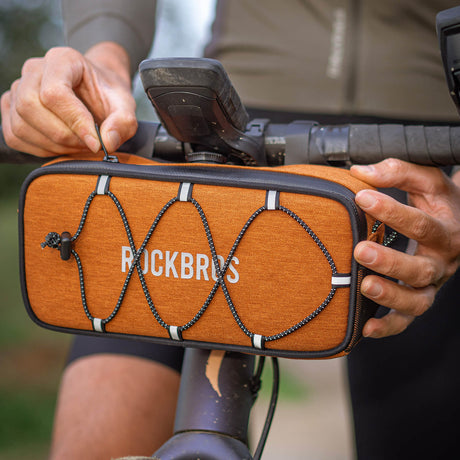
First, lay out everything you actually carry, and only then choose the volume. A small compartment is good if you want to separate your phone and tools from a wet jacket. An example of a solution for small items is the ROCKBROS AS-172, 0.9L waterproof frame bag. Its use makes sense for a short commute when you need quick access to your wallet, keys, or repair kit, but aren't trying to fit all your office luggage.
If your phone is used for navigation, simply keeping it in your jacket pocket can be inconvenient, especially when you need to check a detour. The ROCKBROS 6.7-inch waterproof phone bag with 360° rotation addresses this specific scenario: the screen remains on the handlebars, and the device isn't stored with wet gloves. Before purchasing, measure your phone including its case and check if screen operation through the cover is precise enough for you.
For a longer ride, it's worth separating items used on the way from those that need to arrive untouched. Tools, a spare inner tube, and a snack can go in a small frame bag, while a laptop and shirt can go in a pannier on the rack. This arrangement shortens stops and reduces the number of times the main compartment needs to be opened during rain.

How to pack a laptop, documents, and change of clothes
The two-barrier principle
Laptops, paper documents, and spare socks should have two independent layers of protection. The first is the bike bag, the second is a sealed case tailored to the item. This is not about packing everything in several heavy bags. It's about ensuring that a single zipper failure or a poorly closed flap does not damage the most expensive contents. A ziplock bag for the charger and a separate case for the computer weigh little and organize your luggage.
Do not place your laptop directly against the pannier wall on the wheel side. Water is one problem, impacts are another. A soft layer of clothing can separate the computer from hard tools, but it cannot block a roll-top closure. Place heavier items low and close to the center of the bike. A single heavily loaded pannier changes the bike's handling, so for larger loads, distribute the weight or do a short test ride.
Packing procedure in five steps
- Dry the inside of the bag and check corners, seams, and zippers.
- Place electronics in separate cases; secure chargers and cables separately.
- Place the heaviest items low, without sharp edges pointing at the material.
- Leave a jacket or gloves in an outer, easily accessible zone.
- Close the bag, secure loose straps, and shake the luggage before setting off.
For longer commutes, a small, separate space for tools and dirty small items comes in handy. The ROCKBROS AS-161, 1L waterproof downtube bag can hold an inner tube, tire levers, and a multitool. This prevents metal items from rubbing against the laptop, and after a wet repair, they don't end up in the same compartment as clean clothes. Before mounting, check the clearance above the water bottle and the distance from the front wheel at full turn.
After arriving, do not leave a closed bag with damp clothing all day. Remove the contents, open the compartments, and allow them to dry naturally at room temperature. Musty odors are more often due to trapped moisture than the ride itself. Do not speed up drying directly on a radiator, as high temperatures can damage coatings and glued seams.
Rainwear: dryness without overheating
The most common mistake is wearing a layer that is too warm and not breathable. After two kilometers, the body starts producing moisture faster than the jacket can wick it away. The effect upon arrival can be similar to being soaked through. Dress so that you feel slightly cool for the first two minutes. While pedaling at a relaxed pace, you'll quickly become comfortable, and on a longer climb, you can unzip ventilation.
Three adjustable layers
The base layer should wick away sweat and not absorb it like heavy cotton. A thin mid-layer is only needed in colder temperatures or at a relaxed pace. The outer shell should block wind and rain but allow for adjustment at the neck, cuffs, and underarms. A high waterproof rating alone is not enough if the cut rides up on your back or the sleeves end before your gloves.
Try on the jacket in a cycling-like position. Extend your arms, lean your torso forward, and check if the back still covers your lower back. The hood must not restrict side vision; in city traffic, a well-fitting collar and a thin helmet cover are often safer. Reflective elements help but do not replace proper bike lighting.
Hands, feet, and glasses
Wet hands get cold faster and have less control over the brake levers. Gloves should maintain grip on wet rubber, and their cuffs should work with the jacket sleeves. For shoes, choose covers adapted to your cleat system or regular footwear; a poorly fitting model can snag on the crank. Spare socks in a sealed bag provide a greater improvement in office comfort than another thick layer on your torso.
Glasses protect your eyes from drops and dirt from wheels but can fog up. Position them slightly further from your face, keep ventilation holes clear, and avoid touching the inner surface with a wet glove. If visibility rapidly decreases, stop in a safe place and clean the lenses. Riding "by memory" through several intersections will not save time.
Riding technique on wet asphalt and cobblestones
Brake earlier and more upright
On wet surfaces, reduce your speed before the turn. Braking while heavily leaned over reduces some of the tire grip needed for turning. Straighten the bike, smoothly use both brakes, and gradually increase pressure. After riding through deeper water, gently apply the brakes on a straight section to check their response. Different braking systems behave differently, so get to know your bike outside of an emergency situation.
Leave more space between yourself and cars, other bikes, and pedestrians. Drivers also have limited visibility due to drops on the windshield and mirrors, and a pedestrian under an umbrella might notice the bike path later. Do not ride too close to the curb where water, sand, and leaves collect. Maintain a predictable line of travel for others, signal changes in direction early, and avoid sudden swerving around puddles.
Low-grip surfaces
Painted markings, metal covers, tram tracks, wooden boardwalks, and wet leaves require special attention. Ride over them as straight as possible, without sudden braking or turning. Cross tracks at a clear angle so the tire doesn't get caught in the gap. Slow down before cobblestone sections, as bumps and puddles make it difficult to assess grip.
Do not randomly lower tire pressure significantly hoping for better grip. An overly soft tire can bottom out against the rim, handle poorly under load, and increase the risk of damage. Stick to the tire manufacturer's range, considering the rider's and luggage weight. If you ride regularly in autumn, the condition of the tread and absence of cracks are more important than improvisation.
Visibility is a duty and communication
The Polish Police remind that lights should be turned on after dusk and in conditions of limited visibility, which include rain or fog. A front light helps to spot obstacles, and a rear light allows others to recognize the cyclist earlier. Adjust the light so it doesn't blind oncoming traffic. Before setting off, check the battery level, as cold and frequent use of high mode can reduce actual operating time.

Ten minutes after arriving: bike maintenance after rain
Water alone isn't the only enemy of the drivetrain. The problem is a mixture of moisture, sand, and road debris. Left on the chain, it acts like abrasive paste, and dried on the fork stanchions, it can accelerate seal wear. A short routine after each wet ride is more effective than infrequent, aggressive cleaning of the entire bike.
- Remove fresh mud from the frame, rims, and drivetrain area with a soft brush or damp cloth.
- Dry the chain with a clean cloth, rotating the crank backward without bringing your fingers near the cogs.
- Check that brake pads haven't picked up sand and that discs aren't contaminated with oil.
- After drying, apply lubricant suitable for wet conditions sparingly to the chain links and wipe off any excess.
- Open bags, remove inserts, and allow everything to air dry naturally.
Do not direct a pressure washer stream at bearings, hubs, bottom brackets, headsets, or seals. High-pressure water can push dirt where ordinary rain would not reach. Also, avoid applying lubricant to a dirty chain. Excess product on the outer plates only attracts more contaminants.
Fenders as an element of comfort and maintenance
A well-chosen fender won't keep the bike entirely clean, but it will reduce the stream of water directed at your back, feet, and drivetrain. Before purchasing, check tire width, frame clearance, mounting method, and suspension travel. A rear fender that is too short might protect the saddle but still splash the person riding behind you. After installation, ensure nothing rubs against the tire and that the element doesn't shift on bumps.
Three setups for different rainy commutes
Five kilometers through the city center
For a short route, quick preparation is key. A small bag for a phone and keys, a light jacket, working lights, and the ability to change your top layer upon arrival are sufficient. You don't need a large pannier if you're not carrying a computer. However, a full fender provides an advantage, as most dirt on city sections comes from the wheels, not from drops falling from above.
Fifteen kilometers with a laptop
A longer distance justifies moving luggage from your back to a rack and creating two zones: a dry one for electronics and a working one for your jacket, tools, and food. If you shop after work or travel part of the way by train, the ROCKBROS A41 3-in-1 bag with a capacity of 10.5 liters might be useful. Its value comes from its flexible use, not just the number of features: before choosing, check if it fits your computer, fits your rack, and doesn't interfere with your heel. The model is presented in the "New Arrivals" public collection, but the availability of a specific variant must be confirmed before publication.
Commuting with a child
When riding together, choose a route with fewer intersections and allow extra time. The adult should ride in a way that allows them to see the child and communicate intentions in advance. The child's clothing must allow free head movement and brake operation. Stop the ride if the rain limits visibility or the child is cold; executing the plan is not more important than a safe return.
Regardless of the distance, have a contingency plan. Check where you can shelter, get on public transport, or safely lock your bike. Waterproof equipment increases the range of comfortable conditions, but it doesn't oblige you to continue riding during a thunderstorm, very strong winds, or flooded roads.
Frequently asked questions about cycling in the rain
Is a waterproof bag enough to carry a laptop?
It's not advisable to rely on a single layer for laptop protection. Use a fitted case or a sealed bag inside the main bag, separate the laptop from tools, and avoid placing it directly against the side of the bag facing the wheel. After arriving, check if moisture has collected inside the compartment.
Do you need to turn on lights during the day when it's raining?
If rain limits visibility, turn on your front and rear lights. Polish police materials indicate an obligation to use lighting in conditions of reduced air transparency. Even with light rainfall, lights help others identify cyclists faster.
How to brake on wet asphalt?
Start braking earlier, use both brakes smoothly, and do most of your braking when the bike is upright. Reduce your speed before a turn, increase your distance, and avoid sudden movements on paint, metal covers, leaves, and tracks.
Is a backpack with a rain cover as good as a pannier?
For short distances, it might be sufficient, but a rain cover often offers less protection on the side against your back and shoulder straps. A backpack also increases sweating. A pannier transfers weight to the bike and usually works better with a laptop, provided it is properly mounted.
Which chain lubricant to choose for autumn?
Wet-condition lubricant stays on the drivetrain longer but collects dirt more easily. Apply it to a clean, dry chain, let it penetrate, and thoroughly wipe off any excess from the outer plates. With frequent rainfall, check your drivetrain more often instead of adding more layers of lubricant.
When is it better to forgo riding?
Give up or interrupt your ride when a storm is near, the wind makes it difficult to stay on track, the road is flooded, or visibility drops below a safe level. Rain gear protects against moisture, not every weather hazard.

A plan that works all autumn long
An effective rainy commute doesn't start with buying everything at once. First, improve your technique and the bike's efficiency, then secure your most valuable luggage, and finally, adjust your clothing and bag capacity. After a few rides, note what was actually wet, what you didn't use, and what item was missing. Such an audit is more reliable than a list of universal "essentials."
Prepare a permanent kit by the door: lights, gloves, a thin rain layer, dry socks, a bag for electronics, and a small rag. When everything has its place, morning rain doesn't require frantic packing. Ride slower, look further ahead, and leave a margin for your own errors and those of other road users. It's this margin, not heroism, that allows for regular cycling in autumn.